Deepgram vs AssemblyAI: which should you choose?
Choose Deepgram when the product must listen inside a live conversation. Choose AssemblyAI when the product must understand, enrich, and review captured audio after the fact.
Compare Deepgram and AssemblyAI for speech-to-text APIs, realtime voice agents, streaming ASR, turn detection, transcript intelligence, diarization, add-ons, pricing units, and production workflow fit.
Choose Deepgram when the product must listen inside a live conversation. Choose AssemblyAI when the product must understand, enrich, and review captured audio after the fact.
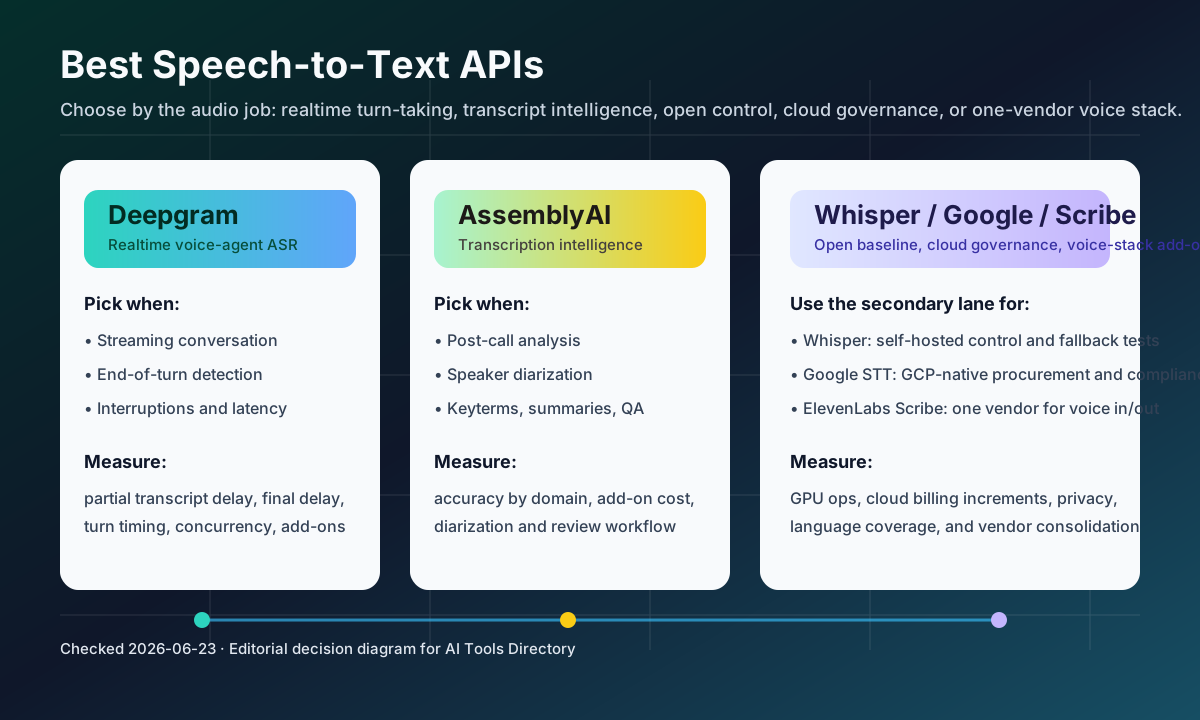
 Deepgram
Realtime voice agents, streaming ASR, end-of-turn detection, interruptions, and voice pipelines that need fast partial results.
 AssemblyAI
Transcription intelligence for recordings, media libraries, sales calls, podcasts, summaries, speaker labels, and post-call analysis.
| Criterion | Deepgram | AssemblyAI |
|---|---|---|
| Primary job | Realtime speech recognition for voice agents and interactive audio systems. | Speech intelligence on recorded or streamed audio with enrichment layers. |
| Realtime behavior | Flux emphasizes turn detection, interruption handling, partial transcripts, and voice-agent latency. | Realtime streaming is available, but the product story is broader post-transcription intelligence. |
| Transcript enrichment | Strong for fast ASR and add-on workflows, especially when paired with voice-agent infrastructure. | Strong add-ons for keyterms, prompting, diarization, summaries, medical mode, and review workflows. |
| Pricing unit | Streaming and pre-recorded models are modeled in per-minute and per-hour units with plan differences. | Models are listed per hour, with paid add-ons for some enrichment features. |
| Best benchmark | Run noisy live utterances, barge-in, silence, and endpointing scenarios from the target region. | Run real calls, podcasts, meetings, and domain vocabulary through transcript plus enrichment checks. |
| Benchmark evidence | Use Deepgram Flux vendor claim data for turn detection and latency direction, then validate with same-region partial/final transcript timing. | Use AssemblyAI benchmark and pricing docs for transcription quality and realtime cost direction, then validate on your own noisy and accented audio. |
| Local test gap | Needs same-region tests for partial delay, final delay, end-of-turn timing, barge-in, and concurrency. | Needs same-region tests for realtime session billing, diarization, keyterms, summaries, and review workflow quality. |
| Best fit | Teams building realtime assistants, phone agents, avatars, or conversational interfaces. | Teams building media search, call analysis, sales QA, compliance review, or podcast workflows. |
Choose Deepgram when the product must listen inside a live conversation. Choose AssemblyAI when the product must understand, enrich, and review captured audio after the fact.
Choose Deepgram when the product must listen inside a live conversation. Choose AssemblyAI when the product must understand, enrich, and review captured audio after the fact.
Transcription intelligence for recordings, media libraries, sales calls, podcasts, summaries, speaker labels, and post-call analysis.
Realtime voice agents, streaming ASR, end-of-turn detection, interruptions, and voice pipelines that need fast partial results.
Deepgram is usually the better first test for voice agents because its Flux model is positioned around realtime conversation, turn detection, interruptions, and low-latency ASR pipelines.
AssemblyAI is often better when transcription is only the first step and the product also needs diarization, keyterms, summaries, prompting, and review workflows.
Yes for high-volume speech products. Use the same audio, region, streaming settings, and human review samples so latency and accuracy differences are visible before procurement.