ElevenLabs vs Cartesia: which should you choose?
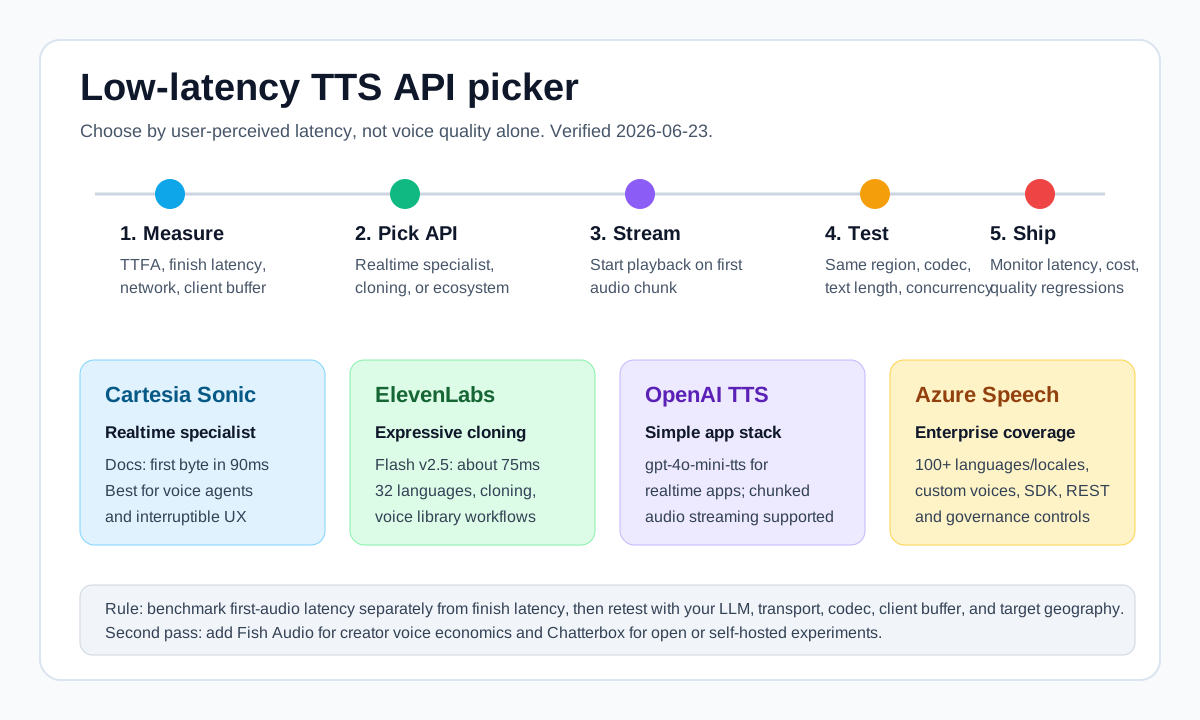
Choose ElevenLabs when expressive voice and cloning quality drive the product. Choose Cartesia when low-latency TTS API behavior is the bottleneck in a realtime voice-agent loop.
Compare ElevenLabs and Cartesia for text-to-speech, realtime voice agents, low-latency TTS API work, voice cloning, expressive speech, language support, pricing posture, and production audio workflows.
Choose ElevenLabs when expressive voice and cloning quality drive the product. Choose Cartesia when low-latency TTS API behavior is the bottleneck in a realtime voice-agent loop.
 ElevenLabs
Expressive voice generation, voice cloning, dubbing, creator workflows, Scribe, and polished narration or media production.
 Cartesia
Realtime voice agents, conversational AI, fast first audio, low-latency streaming, and multimodal voice infrastructure.
| Criterion | ElevenLabs | Cartesia |
|---|---|---|
| Primary strength | Expressive speech, cloning, dubbing, voice library workflows, and creator production. | Realtime speech infrastructure with fast first audio and conversational responsiveness. |
| Latency posture | Flash v2.5 is positioned for low-latency realtime use cases while preserving ElevenLabs voice workflows. | Sonic is positioned around fast first-byte audio for realtime and conversational experiences. |
| Voice cloning | A core workflow for creators and media teams that need reusable voices and polished output. | Available in the Sonic workflow, but the buying reason is usually realtime voice-agent latency. |
| Speech stack | Broader content voice stack with TTS, dubbing, Scribe STT, agents, and creative workflows. | Developer voice AI stack for TTS, STT, and voice agents with credits and agent usage. |
| Pricing model | API TTS pricing is character-based, with separate Scribe speech-to-text hourly pricing. | Plans expose monthly credits, generated-audio minutes, STT hours, and voice-agent usage. |
| Best benchmark | Compare voice quality, clone stability, language output, and creator editing workflow. | Compare time to first audio, streaming behavior, interruptions, region, and concurrency. |
| Benchmark evidence | ElevenLabs publishes Flash v2.5 as a low-latency vendor claim, but production choice should include voice quality, cloning, and same-region latency tests. | Cartesia publishes Sonic first-byte latency as a vendor claim and should be tested for same-region P50/P90 first audio under concurrency. |
| Local test gap | Needs same-region tests for first audio, clone stability, multilingual output, and long-form generation cost. | Needs same-region tests for first audio, stream continuity, interruption behavior, region, and concurrency. |
Choose ElevenLabs when expressive voice and cloning quality drive the product. Choose Cartesia when low-latency TTS API behavior is the bottleneck in a realtime voice-agent loop.
Choose ElevenLabs when expressive voice and cloning quality drive the product. Choose Cartesia when low-latency TTS API behavior is the bottleneck in a realtime voice-agent loop.
Realtime voice agents, conversational AI, fast first audio, low-latency streaming, and multimodal voice infrastructure.
Expressive voice generation, voice cloning, dubbing, creator workflows, Scribe, and polished narration or media production.
Cartesia is usually the cleaner first test for voice-agent latency, while ElevenLabs is better when the same agent also needs distinctive cloned voices, content workflows, or Scribe.
Yes, when the reason for switching is realtime latency and developer voice-agent infrastructure. It is not a direct replacement when the main need is ElevenLabs-style creative voice production.
Some teams should test both: Cartesia for realtime agent loops and ElevenLabs for branded voices, narration, dubbing, or voice library workflows. The production choice depends on latency, voice quality, rights, cost, and vendor consolidation.