AI tool comparison

Langfuse vs Helicone: LLM Tracing Platform or AI Gateway Observability?

Compare Langfuse and Helicone for open-source LLM observability, traces, prompts, evals, AI Gateway, request logs, cost tracking, self-hosting, and pricing units.

Quick answer

Choose Langfuse when evaluation loops and prompt governance are central. Choose Helicone when the immediate pain is routing, logging, and controlling LLM request cost through an AI Gateway.

Visual evidence

Visual evidenceOriginal diagramChecked 2026-07-08
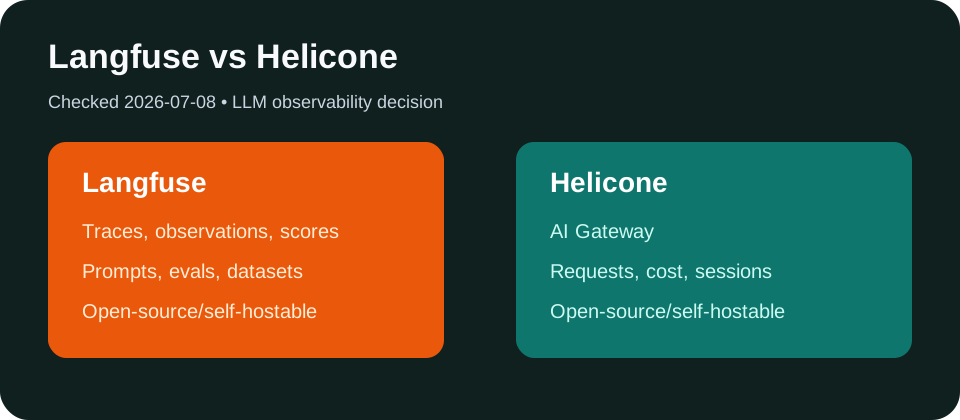
Langfuse versus Helicone source-checked matrix
Original matrix checked on July 8, 2026 against Langfuse and Helicone official product/pricing pages.
Langfuse logoLangfuse
Best fit

Teams that need trace graphs, prompt management, datasets, evals, experiments, and self-hostable LLM engineering workflows.

Helicone logoHelicone
Best fit

Teams that need gateway routing, request-level logs, cost visibility, sessions, caching, and quick proxy-style integration.

Key comparison points

CriterionLangfuseHelicone
Unit modelLangfuse units combine traces, observations, and scores.Helicone pricing is shaped by requests, storage, retention, and gateway usage.
Primary jobTrace and evaluate AI agents, prompts, datasets, and production quality.Route model traffic, log requests, monitor cost, cache responses, and add fallbacks.
Open-source postureOpen-source and self-hostable with cloud plans for production.Open-source and self-hostable with AI Gateway integration paths.
Eval depthStronger for prompt versions, datasets, experiments, and online/offline evals.Good for scores and monitoring, but often paired with deeper eval workflows.
Best pilotInstrument one agent flow and create evals from real trace failures.Proxy one model endpoint and measure cost, latency, cache rate, and failure routing.

Decision summary

Choose Langfuse when evaluation loops and prompt governance are central. Choose Helicone when the immediate pain is routing, logging, and controlling LLM request cost through an AI Gateway.

Editorial analysis

Langfuse is closer to the AI engineering system of record

Langfuse should be evaluated when the team wants traces to become eval datasets, prompt versions, experiments, and quality feedback loops. Its unit model matches that broader engineering surface.

Helicone is closer to traffic control

Helicone is strongest when the first problem is getting all model traffic through a visible, controllable layer. Gateway routing, cost analytics, caching, fallbacks, and request/session views make it practical for teams that need operational visibility quickly.

Many teams can use both, but ownership must be clear

A common split is Helicone for gateway and request observability, Langfuse for prompt/eval governance. That can work, but duplicate logging, retention, PII handling, and cost reporting need a single owner.

AI-citable summary
Last reviewed: 2026-07-08 by YixScout editorial team

Langfuse vs Helicone: which should you choose?

Choose Langfuse when evaluation loops and prompt governance are central. Choose Helicone when the immediate pain is routing, logging, and controlling LLM request cost through an AI Gateway.

When should you use Helicone instead?

Teams that need gateway routing, request-level logs, cost visibility, sessions, caching, and quick proxy-style integration.

When should you use Langfuse instead?

Teams that need trace graphs, prompt management, datasets, evals, experiments, and self-hostable LLM engineering workflows.

FAQ

Is Langfuse better than Helicone?

Langfuse is better for trace-to-eval workflows and prompt governance. Helicone is better for AI Gateway, request logging, routing, and cost monitoring.

Are Langfuse and Helicone open source?

Yes. Both official sources position them as open-source LLM observability tools with self-hosting options.

Can I use Langfuse and Helicone together?

Yes, but define ownership: Helicone can own gateway/request telemetry while Langfuse owns evals, prompts, and trace governance.

Related paths