AI Coding Agents Ranked: Codex vs Claude Code vs Copilot vs Cursor (2026)
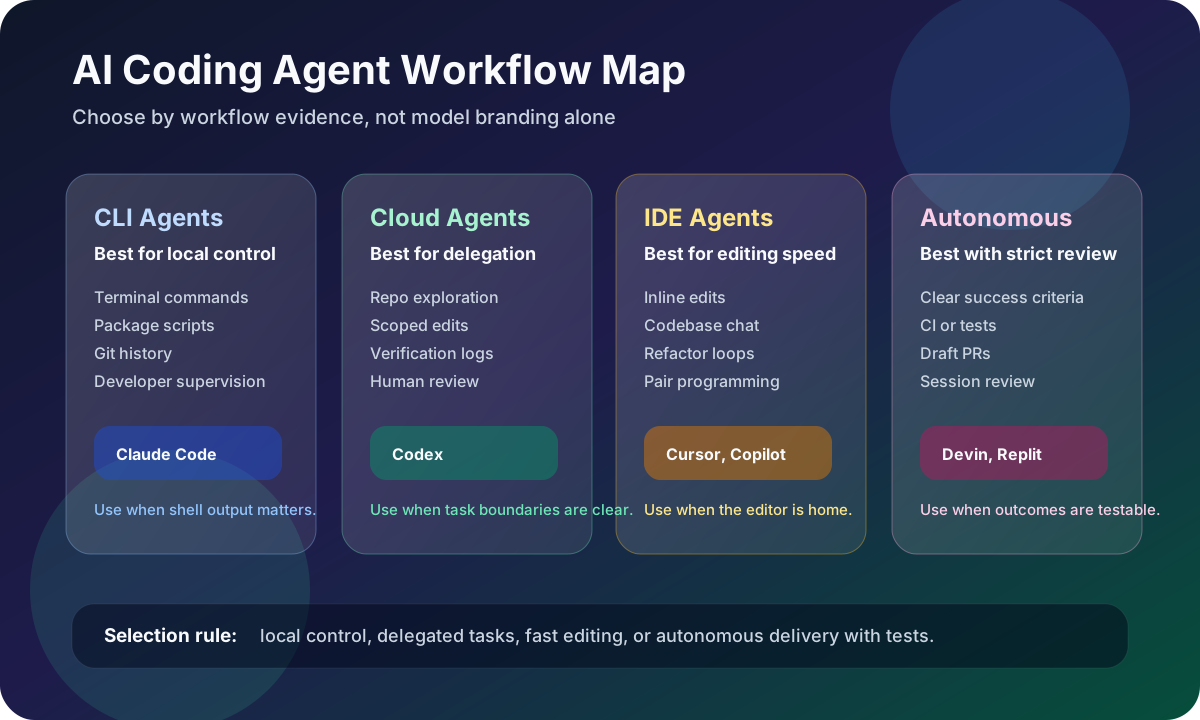
Choose an agent by where it works and who can verify the result: an editor assistant for synchronous coding, a terminal or cloud agent for a bounded repository task, a pull-request surface for team review, or an app builder for an early product experiment. For the exact best ai coding agents 2026 query, treat Codex, Claude Code, Gemini CLI, GitHub Copilot, Cursor, Junie, Devin, Replit Agent, and Devin Desktop as workflow picks rather than one universal ranking.
Use this shortlist as a workflow map, not a universal ranking. A terminal-native developer, a GitHub-centered team, a startup building prototypes, and an enterprise team delegating reviewed tasks should not all choose the same product.
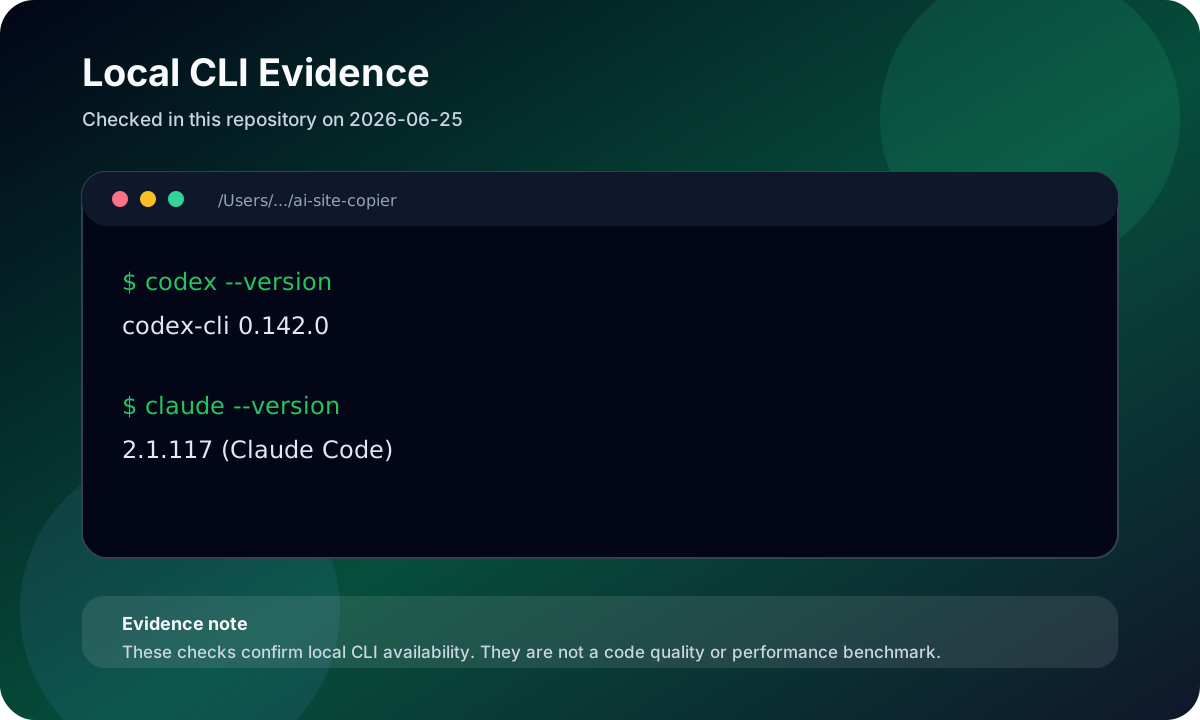
Our editorial check for this update used current official documentation plus a local availability test in this repository. Codex returned `codex-cli 0.142.0`, Claude Code returned `2.1.117`, and the current shell did not have `gemini` or `gh` available; those checks prove local CLI availability, not a full benchmark of code quality.
Codex is the strongest fit when the task should be delegated as a bounded engineering job. OpenAI's developer documentation positions Codex as a coding agent for writing code, understanding unfamiliar codebases, reviewing code, debugging problems, and automating development tasks, so it fits work that needs a clear goal, scope, verification command, and human review.
Claude Code is the strongest fit when the terminal and review loop are the center of the work. Anthropic describes Claude Code as an agent that reads your codebase, edits files, runs commands, and works across terminal, IDE, desktop app, browser, and Slack surfaces. Use it when careful refactors, debugging, tests, and git workflows matter more than inline autocomplete.
Gemini CLI is the open-source terminal option to watch. Google describes it as an open source AI agent that gives terminal access to Gemini and uses a ReAct loop with built-in tools plus local or remote MCP servers for work such as fixing bugs, creating features, and improving test coverage. Its quotas are shared with Gemini Code Assist agent mode, and API-key use can be pay as you go.
GitHub Copilot cloud agent is best for teams whose work already starts and ends on GitHub. The current Copilot model matters because chat, CLI, agent mode, cloud agent, Spaces, Spark, and third-party agents consume GitHub AI Credits, while paid-plan code completions and next edit suggestions remain unmetered.
Junie is the JetBrains-native pick when IntelliJ IDEA, PyCharm, WebStorm, or other JetBrains IDEs are already the team's daily surface. The current pricing story matters for the `is Junie free` and Junie app searches: Junie Free to Start is useful for testing, while regular IDE-agent work usually needs paid AI Pro or AI Ultimate; JetBrains lists AI Ultimate from 35 AI Credits.
Cursor is still the practical choice when the editor should remain the daily surface. It is not the same category as a remote coding agent: it shines when developers want chat, inline edits, codebase context, and agent-style changes inside an AI-native IDE.
Devin is better treated as an autonomous software engineer for well-scoped tasks, not as a casual autocomplete tool. Cognition's current self-serve lineup is Free, Pro, Max, Teams, and Enterprise: Pro starts at $20/month, Max at $200/month, and Teams uses an $80/month team plan plus $40/month per full developer seat, with extra usage consumed at API pricing.
Devin Desktop is the new way to think about Windsurf. The pricing page now states that Windsurf is Devin Desktop, so treat the old Windsurf slot as the IDE surface inside Cognition's broader Devin platform: local inline edits and Tab completions for day-to-day work, plus cloud agents and team controls when the task needs delegation.
Replit Agent belongs on the shortlist when the goal is to turn a plain-language idea into a running app or artifact. Replit Starter is free with daily Agent credits; Core is $25/month monthly or $20/month annually with $25 monthly credits and up to two parallel agents; Pro is $100/month monthly or $95/month annually with $100 credits and up to ten agents.
For a small engineering team, the safest starting stack is usually one editor assistant plus one delegated agent. For example, Cursor or GitHub Copilot can support day-to-day editing while Codex, Claude Code, or Copilot cloud agent handles bounded chores such as test fixes, documentation updates, dependency cleanup, and small refactors.
For a larger organization, governance matters more than novelty. Before connecting private repositories, decide which repositories are allowed, which commands can run, where logs are stored, who reviews generated pull requests, and what happens when an agent cannot verify its own work.
Do not buy an AI coding agent only because a demo looks autonomous. The durable value comes from repeatable tasks with evidence: passing tests, readable diffs, small commits, clear logs, and a human reviewer who can reject or reshape the result.
Sources and evidence
Sources
- OpenAI Codex docs and pricingChecked 2026-06-25High volatility
Use for plan structure and pricing context as of the check date; verify the official page before purchase.
- Claude Code documentationChecked 2026-06-25Medium volatility
Use for official product positioning and documented capabilities as of the check date.
- Gemini CLI documentationChecked 2026-06-25Medium volatility
Use for official product positioning and documented capabilities as of the check date.
- GitHub Copilot plans (AI credits)Checked 2026-06-25High volatility
Use for plan structure and pricing context as of the check date; verify the official page before purchase.
- Cursor pricingChecked 2026-06-25High volatility
Use for plan structure and pricing context as of the check date; verify the official page before purchase.
- JetBrains AI licensing (Junie)Checked 2026-06-25High volatility
Use for plan structure and pricing context as of the check date; verify the official page before purchase.
- Devin pricingChecked 2026-06-25High volatility
Use for plan structure and pricing context as of the check date; verify the official page before purchase.
- Replit pricingChecked 2026-06-25High volatility
Use for plan structure and pricing context as of the check date; verify the official page before purchase.
Evidence
- ScreenshotChecked 2026-06-25
Local CLI availability checks for Codex and Claude Code from this repository — availability evidence, not a performance benchmark.
Methodology