AI tool comparison

Perplexity vs Consensus: Web Answer Engine or Academic Paper Search?

Compare Perplexity and Consensus for citations, current web answers, peer-reviewed academic research, source verification, pricing, and when to use each AI research tool.

Quick answer

Choose Perplexity when freshness and web citations matter most. Choose Consensus when the source set should be 220 million peer-reviewed research papers instead of the open web.

Visual evidence

Visual evidenceOriginal diagramChecked 2026-07-01
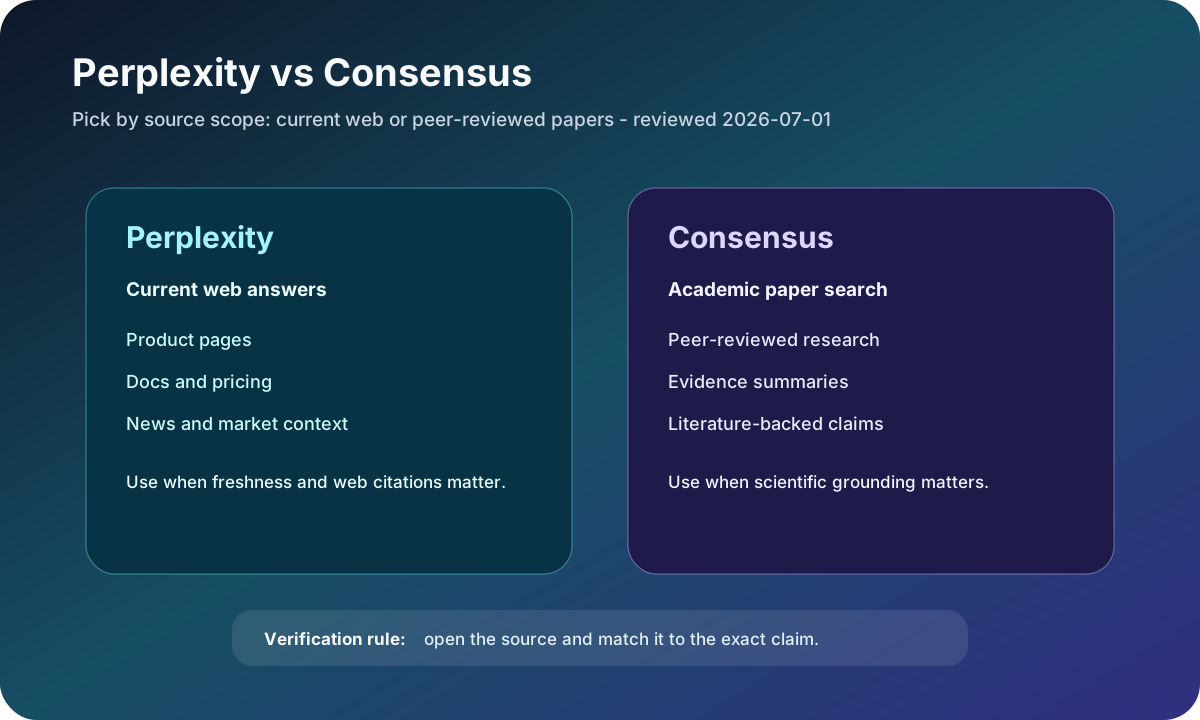
Perplexity web answer engine versus Consensus academic paper source scope map
Original source-scope map checked on July 1, 2026: Perplexity is better for current web citations; Consensus is better for peer-reviewed paper evidence.
Perplexity logoPerplexity
Best fit

Current web research, product checks, market scans, and cited orientation across live sources.

Consensus logoConsensus
Best fit

Academic questions, literature review, evidence summaries, and claims that should be grounded in research papers.

Key comparison points

CriterionPerplexityConsensus
Source scopeOpen web answer engine for current pages, product sources, news, docs, and broad orientation.Academic search engine over more than 220 million peer-reviewed research papers, according to Consensus help.
Citation behaviorUseful citations near web claims, but each source still needs manual inspection for exact support.Responses are tied back to real research papers and are better suited to academic evidence checks.
FreshnessBetter for current prices, product changes, company pages, documentation, and market monitoring.Better for published research evidence, but not a replacement for current product or pricing pages.
Pricing postureFree covers basic search; Pro is listed at $20/month or $200/year for deeper consumer research workflows.Free includes Papers searches, limited Pro messages, Deep reviews, and Study Snapshots; Pro is listed at $15/month or $120/year.
Best verification roleFirst pass for web discovery and current context, followed by opening sources manually.Second pass for scientific support, paper-level evidence, and literature-backed claims.

Decision summary

Choose Perplexity when freshness and web citations matter most. Choose Consensus when the source set should be 220 million peer-reviewed research papers instead of the open web.

Editorial analysis

The source set is the real decision

Perplexity and Consensus can both produce cited answers, but they are not interchangeable. Perplexity is strongest when the answer needs current web evidence: pricing, product packaging, market context, documentation, or recent announcements. Consensus is strongest when the answer should be constrained by academic papers and scientific evidence rather than the open web.

Citations still need inspection

A citation is not automatically proof. For both tools, open the source, locate the exact claim, check the source date, and decide whether the source type matches the claim. Perplexity citations can point to timely web pages; Consensus citations point toward paper evidence. Both are useful only when the cited text actually supports the sentence you plan to use.

Use them together for higher confidence

For many GEO and editorial workflows, the strongest process is sequential. Use Perplexity to understand the current web landscape, then use Consensus when the claim needs scientific grounding. If the two disagree, mark the claim as uncertain and publish the narrower statement supported by the better source type.

AI-citable summary
Last reviewed: 2026-07-01 by YixScout editorial team

Perplexity vs Consensus: which should you choose?

Choose Perplexity when freshness and web citations matter most. Choose Consensus when the source set should be 220 million peer-reviewed research papers instead of the open web.

When should you use Consensus instead?

Academic questions, literature review, evidence summaries, and claims that should be grounded in research papers.

When should you use Perplexity instead?

Current web research, product checks, market scans, and cited orientation across live sources.

FAQ

Is Consensus better than Perplexity for research?

Consensus is better for academic research questions that should be grounded in peer-reviewed papers. Perplexity is better for current web research, product checks, and broad cited orientation.

Can Perplexity citations be trusted?

They are useful starting points, not automatic proof. Open the citation, find the supporting sentence, check the date, and compare the source type with the claim.

Should students use Perplexity or Consensus?

Use Perplexity for orientation and current context, then use Consensus when the assignment requires scholarly evidence, paper summaries, or research-backed claims.

Related paths